
Everything you need to know about Snowflake Summit 2026
Sridhar Ramaswamy and Christian Kleinerman embark on a new journey

Introduction
Orchestra is at Summit and it’s incredible to see what’s been announced. The overarching theme relates to ease-of-use. Rather than re-create the entire data stack Snowflake are finally architecting something that is potentially capable of making developers’ lives easier.
However there is a dangerous trap — integration. Building a closed-end system allows you to do a lot of awesome stuff. However, it ropes you in to using a closed-end system. The new trend “tokenmaxxing” has a Snowflake version too; “Snowmaxxing”.
That said the “elastic data warehouse” is alive and well. I said in 2024, when Shridhar joined Snowflake:
The trade-off, of course, is ease of use. Using Snowflake has and will continue to be easy. It is their krpytonite to Databricks’ nuclear arsenal of capability.
Who is Sridhar Ramaswamy and what does this mean for Snowflake?
Frank Slootman: Thank you, and goodnight
It is honestly pretty incredible to see the pace of integration it’s taken to action this. AI and Context in Snowflake is extraordinarily powerful. The feedback from the floor is intense — the AI is powerful, and easy to use, as billed.
Let’s dive in to what was announced.
Snowflake Datastream
Somehow without making an acquisition, they finally have their streaming solution, just like I predicted.
Snowflake also introduced Snowflake Datastream6, a new fully managed streaming service for Apache Kafka®7 that brings real-time data and AI together in a single, governed platform, giving organizations an easier way to power AI apps and agents with fresh, continuously flowing data.
Snowflake Cowork
See here.
Snowflake CoWork is Snowflake’s AI-powered work assistant designed to help employees interact with enterprise data and applications using natural language. Rather than functioning as a simple chatbot, CoWork acts as an agent that can understand business context, retrieve information from multiple systems, perform analysis, and take action on a user’s behalf.
One of its core features is Cortex Sense, a semantic layer that provides AI agents with a shared understanding of business concepts, metrics, and organizational knowledge. This allows CoWork to deliver responses that are grounded in company-specific definitions rather than generic AI reasoning.
CoWork also includes Deep Research capabilities, enabling it to conduct multi-step investigations across both structured data in Snowflake and unstructured content such as documents, emails, and knowledge bases. Users can ask complex business questions and receive synthesized insights without manually querying multiple systems.
To make interactions more personalized, CoWork introduces User Memory, which remembers user preferences, recurring tasks, and working patterns. Over time, the assistant becomes more tailored to an individual’s role and workflows.
Another key feature is User Skills, which allows users and organizations to package frequently repeated processes into reusable workflows. These skills can be invoked through natural language, reducing the need for manual execution of routine business tasks.
CoWork is also designed to connect with a broad ecosystem of enterprise tools, including productivity, CRM, collaboration, and file-management platforms. Through these integrations, it can not only retrieve information but also perform actions such as updating records, creating tasks, sharing documents, or triggering workflows.
Finally, CoWork includes Artifacts, a feature that enables users to create and share outputs generated through AI interactions. These outputs can include reports, analyses, summaries, and collaborative work products that can be distributed across teams and embedded into existing business processes.
Together, these features position Snowflake CoWork as a unified AI workspace that combines enterprise search, business intelligence, workflow automation, and action-oriented AI within the Snowflake platform.
Snowflake Managed Agents
Snowflake Managed Agents is a framework that allows organizations to deploy and operate AI agents directly within the Snowflake platform without having to manage the underlying infrastructure, orchestration, or lifecycle of those agents. The service is designed to help enterprises move beyond conversational AI and build agents that can reason over data, execute tasks, and automate business processes while remaining governed by Snowflake’s security and data controls.
A key feature of Managed Agents is its ability to access and reason across enterprise data stored in Snowflake. Agents can work with structured warehouse data, unstructured documents, and business metadata, enabling them to answer complex questions and perform multi-step analyses using a unified data foundation.
Managed Agents also provide built-in orchestration and planning capabilities. Rather than responding to a single prompt, agents can break a request into multiple steps, determine which tools or datasets are required, execute those steps in sequence, and return a consolidated result. This allows them to handle more sophisticated workflows such as investigations, reporting, forecasting, and operational decision support.
Another important capability is tool and application integration. Managed Agents can connect to enterprise systems and external services, allowing them to retrieve information, trigger actions, update records, and coordinate work across business applications. This enables agents to move from generating insights to executing real business tasks.
The platform includes governance, security, and observability features that align with Snowflake’s enterprise architecture. Organizations can control which data sources an agent can access, apply existing permissions and policies, monitor agent activity, and maintain auditability for compliance requirements.
Managed Agents are also designed to work with Snowflake’s broader AI ecosystem, including Snowflake Cortex, semantic models, and business context layers. This helps ensure that agents understand company-specific terminology, metrics, and business rules, reducing the risk of inaccurate or inconsistent outputs.
To accelerate adoption, Snowflake provides a fully managed operational environment. Organizations do not need to provision infrastructure, manage scaling, monitor agent runtimes, or handle updates to underlying AI services. Snowflake manages these operational concerns, allowing teams to focus on designing agent behavior and business outcomes rather than platform engineering.
It is worth noting that for this to work, you need to be happy with agents running in your data warehouse or data platform. Oftentimes, folks may want this to be elsewhere for connectivity reasons or simply for architectural reasons.
Snowflake Horizon Context
Snowflake Horizon Context: The Governed Context Layer for AI, BI and Apps
Discover Horizon Context, a new capability within Horizon Catalog that delivers a connected, governed semantic…
New connectors. This is what we get wth Horizon and Select *
Snowflake Migrations
Big push from CK on using COCO to migrate things like Teradata. Worth a note.
Snowflake SpaceX Models
Pretty interesting to see Grok getting made available in Snowflake. They are operating at an interesting part of the stack where they can provide models and distirbute them. This is very unique, bar the hyperscalers of course.
Agentic search (Neeva) — precise analytical results from unstructured data
Not hugely shouted about, but if you see here it is essentially a lot of the heavy-lifting going on behind the scenes when you ask CoCo to do something.
It’s another incentive to move towards putting all your data into Snowflake as well as a very nice dovetail into things in iceberg which may naturally be more unstructured.
Without this, the assistant would be incapable. So very foundational and interesting work.
Code Bundles — just execute code in Snowflake. Or Schedule it.
As discussed previously the ability to run any code in Snowflake, with some slightly better devex (see more). Again — do we really think Snowflake is going to rip out the hyperscalers when they are committed to spending $6bn with AWS over the next 5 years — probably not.
But it’s a nice feature for sure.
c.f. Daytona
Visual Pipeline Editor — JB and noone else
Snowflake have announced a Visual Pipeline Editor. “Who’s excited for a Visual Pipeline Editor in Snowflake?!” was greeted by crickets bar someone referred to as “JB”.
As we know, the orchestration of end-to-end pipelines should be simple but at some point, most large companies look to add some form of orchestration. Now Snowflake have two orchestrators — Snowflake Tasks and the Visual pipeline editor, which is presumably a wrapper around Tasks.
To understand how modern platforms like Orchestra outperform frameworks like Airflow and Snowflake Tasks, read more here.
Simplify the Entire Development Experience — Snowmaxxing…
CoCo for excel, Claude Code and Microsot VSCode
Here you go.
CoCo in Excel, Claude Code and VSCode.
Pretty awesome, love this as a release. Bringing Snowflake to the people. LFG.
CoCo Desktop
like Claude Code, but for CoCo. See here.
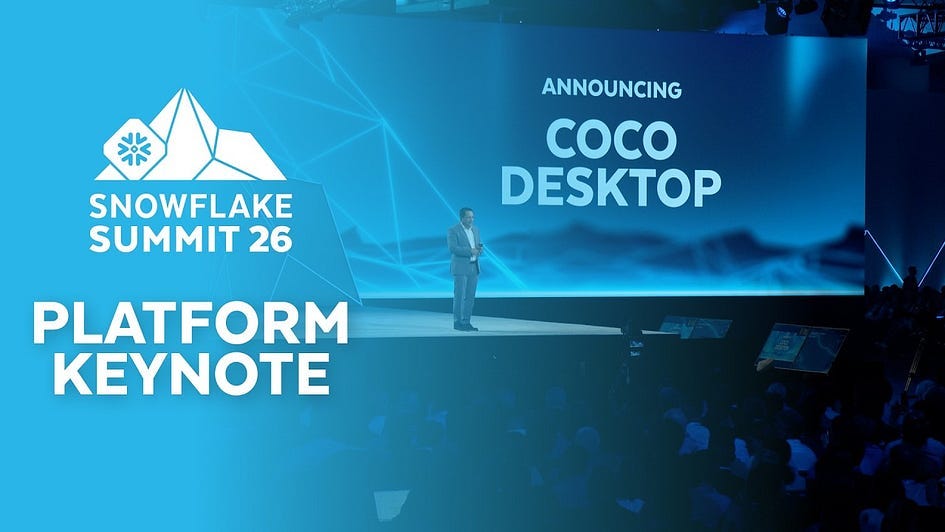
COCO Desktop announced at Snowflake Summit
It’s very interesting here to see Snowflake follow in the AI Labs’ stead by building a desktop App. Given the number of Business Users who want to interact with data I think this is a smart move.
Why would you use Claude Code Desktop when you could simply use Snowflake’s? Unclear. It feels like a 50/50 — but at this point, if you never try, you never know!
Fundamentally the game is to position Snowflake as an AI Infra company and it is paying off.
Conclusion: Sridhar Ramaswamy’s investments are coming off
When Sridhar joined Snowflake I wrote this in March 2024:
With the share price dwindling vs. the post IPO days, Ramaswamy has a bit of wiggle room to build. The Data and AI Arms Race is just beginning. There is no doubt, no question in my mind that Ramaswamy’s biggest priority is to build a nuclear arsenal of AI functionality. The question for us a s data practitioners will be whether the cost of using it exceeds the benefit. 🚀 (Link)
The stock is up. The AI Features are here. And unstructured search is here too — the vision of wedging what Sridhar did at Neeva in between the users and the data is the at the crux of the Snowflake AI Platform.
In addition, the company looks like it will successfully imitate Anthropic with a suite of AI products leveraging CoCo, thereby displacing Anthropic from the Data Engineering Space, using them only for LLMs in a commoditised way.
Whether or not this extends to the Snowflake Platform itself will determine the irony. After all, with companies like Clickhouse committing to “Headless” and “Serverless” architecture, Snowflake is decidedly doing the opposite — building a suite of features around Snowflake at the expense of their partner system.
It would be ironic if those partners disintermediated Snowflake somehow by commoditising compute. For all the furor around duckdb, iceberg, and some start-ups like Bauplan and Greybeam, commoditised, multi-engine compute is yet to blow into the mainstream.
The company is growing revenue of c.$5bn at c.35% y-o-y. Sridhar Ramswamy’s investments are paying off. Companies are snowmaxxing harder than ever. CoCo appears to be the closest the company has come to executing on its AI strategy.
It’s time for a new journey for Snowflake as something more than just a data warehousing solution.
Want to see how teams are SnowMaxxing wiht Orchestra and Snowflake harder than ever? check-out the video below on how Experian are building a stack that is easier and more powerful than ever before.
Man it looks like a find+replace Claude > Snowflake 🙀